
The global digital landscape is undergoing a monumental shift as ChatGPT overtakes TikTok in global mobile store rankings. For years, social media platforms dominated consumer downloads across every major marketplace. However, recent data confirms that utility-driven AI software dominates 2026 download metrics. Users now prefer actionable assistance over passive video scrolling.
This sudden transformation marks a pivotal turning point for the entire technology ecosystem. Mobile devices are evolving into hyper-personalized digital assistants. Consequently, standalone entertainment apps face unprecedented competition from intelligent software. In this deep dive, we examine the structural forces pushing artificial intelligence past traditional social platforms.
The Historic Shift: Key Metrics and Data
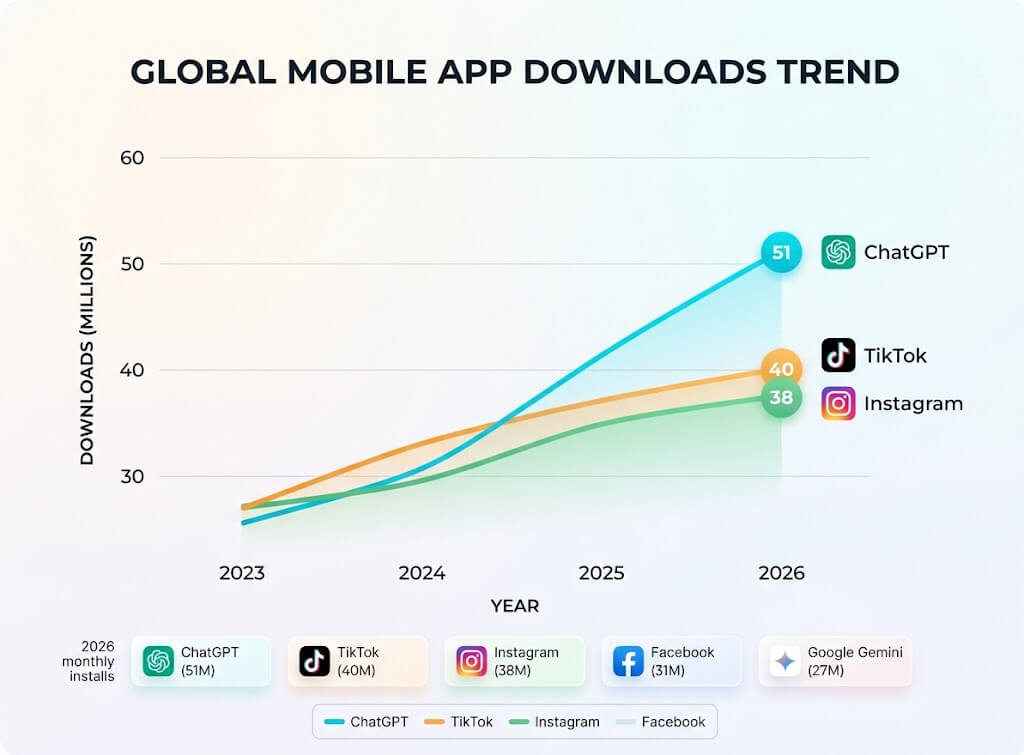
The latest monthly tracking data from Appfigures Intelligence reveals remarkable download volume changes across app ecosystems. OpenAI’s mobile application achieved over 51 million installs in a single month. Meanwhile, short-form video giant TikTok claimed the second position with approximately 40 million downloads.
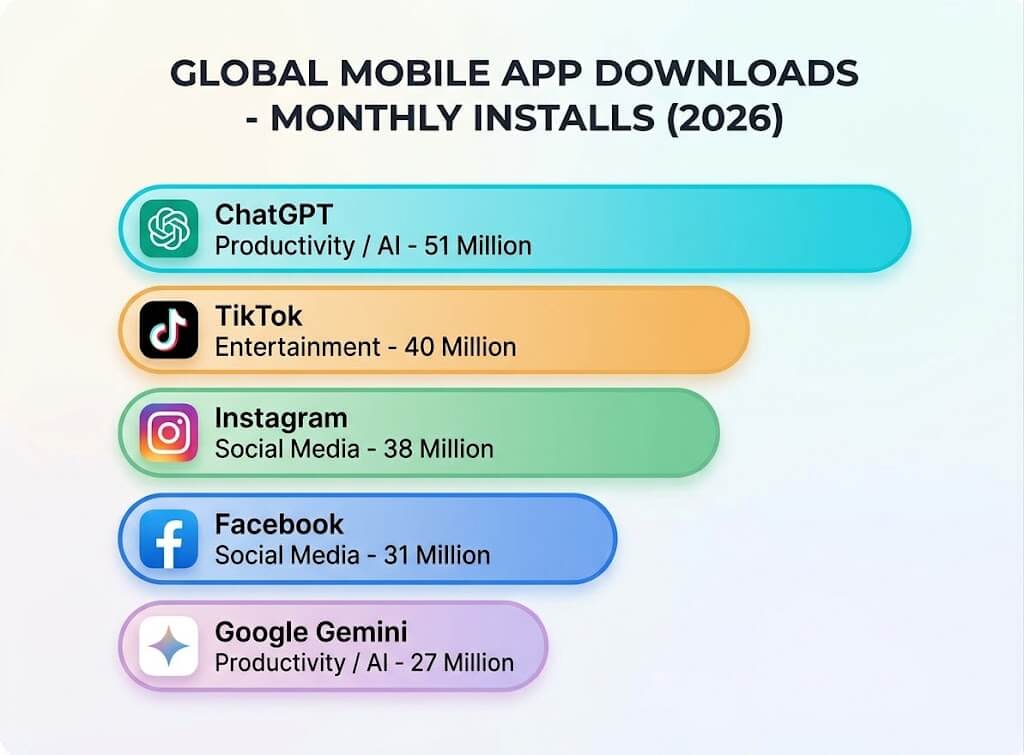
According to market research published by Gartner, end-user spending on intelligent application platforms continues to scale rapidly. Consumer habits clearly favor tools that save time rather than consume it. Furthermore, competitors like Google Gemini are also securing top-tier global placement.
⚠️ Warning: Relying solely on short-form entertainment software can limit daily personal output. Integrating intelligent workflow assistants directly into your mobile device dramatically lowers friction for daily problem-solving.
Why Users Are Replacing Entertainment with Utility
The transition toward utility platforms stems from changing user priorities. Users want immediate answers to technical questions rather than endless algorithmic media feeds.
- Instant Problem Solving: Users generate code snippets, draft complex documentation, and analyze raw datasets in real time.
- Workflow Integration: Advanced APIs connect generative systems with existing email clients and cloud repositories.
- Personalized Learning: Voice interfaces allow natural, back-and-forth educational tutoring sessions on demand.
In addition, hardware manufacturers now design silicon tailored specifically for local neural processing. These hardware improvements guarantee fast execution times and lower network latency.
The Mechanics Driving Mass AI Application Adoption
Massive growth in AI application adoption relies heavily on seamless user onboarding. Users no longer need complex prompt formatting to receive precise responses. Natural language understanding allows non-technical users to query database structures comfortably.
💡 Pro-Tip: Set up custom instructions within your primary assistant app to enforce concise outputs and skip automated disclaimers during intensive research tasks.
Enterprise investment also accelerates consumer distribution. Industry reports hosted at IDC highlight continuous expansion in enterprise infrastructure spending. Workers adopt these applications personally because they rely on them professionally.
Social Media’s Saturation and the Rise of Productivity Software Growth
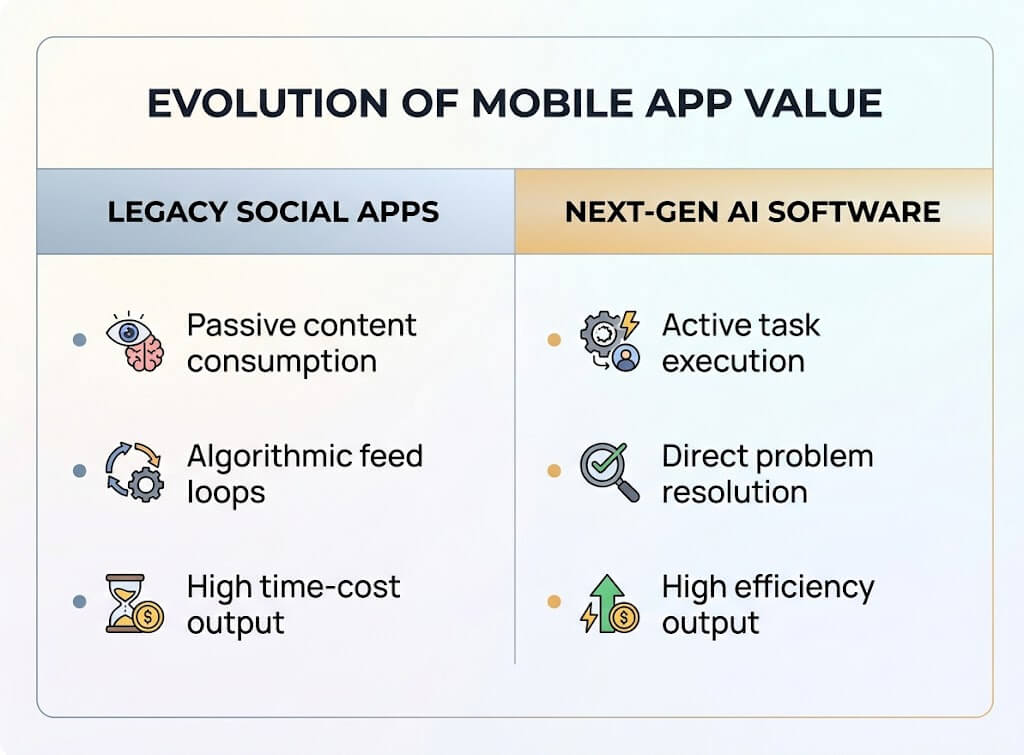
Social media algorithms face structural monetization bottlenecks. Ad-supported feeds require constant user attention to extract financial value. In contrast, modern subscription frameworks monetized through app stores yield consistent recurring revenues.
This dynamic drives massive productivity software growth worldwide. Developers continuously refine agentic capabilities to carry out complex multi-step workflows. Consequently, users migrate away from static media platforms into action-oriented application suites.
The global economy demands real-time software versatility. Tracking studies from Statista illustrate shifting screen-time ratios among core demographic groups. Users increasingly view mobile devices as complete production workstations.
What the Future Holds for Mobile App Ecosystems
As software developers expand mobile edge capabilities, intelligent assistants will run entirely on-device. Privacy safeguards will improve as context processing happens without remote server uploads.
Traditional apps must adapt or face declining user engagement metrics. Platforms that integrate conversational engines directly into their core services will remain competitive. Otherwise, unified assistant models will aggregate third-party functions into simple, text-based interfaces.
For comprehensive architectural breakdowns on neural software developments, explore the tech deep dives available at TechCrunch. The shift toward action-focused software represents a permanent structural transformation in personal computing.
Final Thoughts
The fact that ChatGPT overtakes TikTok serves as a definitive indicator for the tech sector. Mobile computing has shifted from casual media consumption toward direct cognitive enhancement. As generative AI tools continue to evolve, the distinction between operating systems and individual software applications will dissolve. The era of passive scrolling is giving way to interactive digital productivity.
What are your thoughts on this app store transformation? Are you spending more time on utility platforms than social media this year? Drop your thoughts in the comments section below, and share this article with your fellow tech enthusiasts!